How to Choose the Right Heavy Duty Ratchet Straps for Heavy Gear
If you haul heavy gear like a UTV, a zero-turn mower, or a vintage car, you have likely searched for “heavy duty straps” to keep your investment safe. But what does that label actually mean?
Many transporters assume that anything labeled “heavy duty” is strong enough to secure their heavy gear. The reality is that “Heavy Duty” is often just a marketing term. The Federal Motor Carrier Safety Administration (FMCSA) does not explicitly define a “heavy duty” category for tiedowns. Instead, safety is determined by specific performance calculations and the Working Load Limit (WLL).
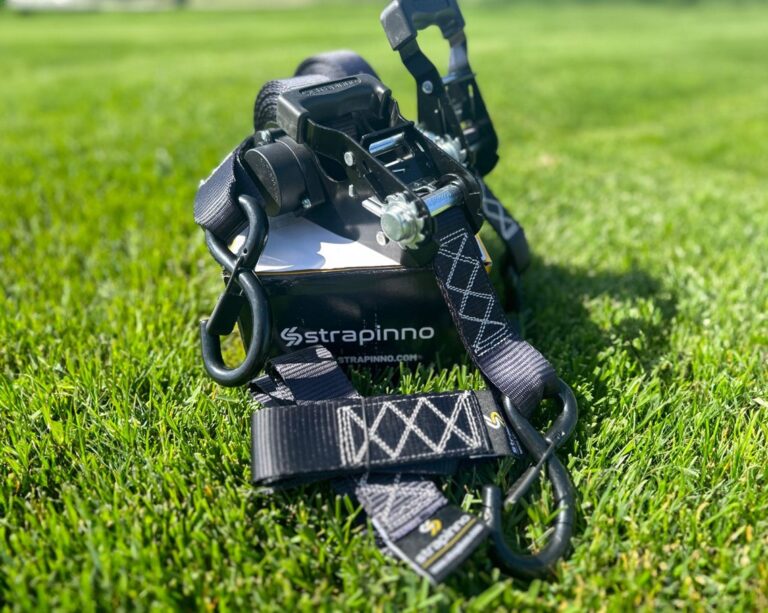
This guide will explain how to choose the right strap strength for your heavy gear and introduce you to some of Strapinno’s Retractable Ratchet Straps (or transport straps are what we call them) to get the job done!
Break Strength vs. Working Load Limit
When you see a strap labeled “10,000 lbs,” it is important to know if that number refers to the Break Strength (BS) or the Working Load Limit (WLL).
• Break Strength (BS): This is the absolute maximum force the strap can withstand before failing.
• Working Load Limit (WLL): This is the rating you must use for daily safety. The industry standard for ratchet straps is to calculate WLL by dividing the Break Strength by three.
The Market Standard:
• 1-inch straps are generally considered “light-duty,” often maxing out around 1,000 lbs WLL.
• 3-inch and 4-inch straps are used for industrial flatbed trucking, with WLLs exceeding 5,000 lbs.
For most heavy gear (cars, ATVs, machinery), a 3-inch strap is too bulky, but a 1-inch strap is too weak. Strapinno’s 2 in x 12 ft Retractable Ratchet Straps bridge this gap. We provide a massive 5,000 lbs Break Strength and a 1,667 lbs WLL per unit, giving you security in a size that fits your trailer and equipment.
Read more: Breaking Strength vs Working Load Limit: What’s the Difference?
The 50% Rule: How to Calculate WLL for Heavy Gear
The Rule: The combined WLL of all straps used to secure your load must be at least one-half (50%) of the weight of the article. That being said, if you are hauling a heavy UTV weighing 2,500 lbs, you need straps with a combined WLL of at least 1,250 lbs (50% of the vehicle weight), so in this case, if you use 1-inch straps (usually around ~500–1,000 lbs WLL), you are operating near their limit, which we wouldn’t recommend doing for your safety.
Strapinno’s Transport Retractable Ratchet Straps (Heavy Duty Straps)
Ready to secure your load? Compare our retractable ratchet straps below. From 1.5-inch straps to 10,000-lb rated straps for heavy transport, here are the specs you need to know. FYI, our 1.5 in x 12 ft and 2 in x 12 ft straps are equipped with stainless steel springs for extra durability!
| Product | WLL / BS | Hook Type | Suitable for |
| 2″ × 12’ S Hook (2-Pack) | 1,667 / 5,000 lbs | S-Hook | ATV, UTV, Lawn Equipment and cargo |
| 2″ × 15’ E-Track (2-Pack) | 1,500 / 4,500 lbs | E-Track | E-track system. Secure ATV, UTV, Cargo, etc. |
| 1.5″ × 12’ S Hook (2-Pack) | 1,617 / 4,850 lbs | S-Hook | ATV, UTV, Car, Truck and cargo |
| 1.5″ × 20’ Double J Hook | 2,200 / 6,600 lbs | D-Ring | ATV, Passenger Car, Trailer, Watercraft |
| 2’’ x 15’ Snap Hook | 3,333 / 10,000 lbs | Snap hook | ATV, UTV, Car, Truck and cargo |
| 2’’ x 16’ Snap Hook | 3,333 / 10,000 lbs | Snap hook | ATV, UTV, Car, Truck and cargo |
| 2″ × 27’ Double J Hook | 3,333 / 10,000 lbs | J-Hook | ATV, UTV, Boat, Car, Truck and cargo |
| 2″ × 27’ Flat Hook | 3,333 / 10,000 lbs | Flat | ATV, UTV, Boat, Car, Truck and cargo |
How to Choose Your Strapinno Strap?
Having too many choices can be confusing. You might wonder, “If all these straps are rated for heavy loads like ATV, UTV, Boat, Car, Truck and cargo, why does it matter which one I pick?”
The answer comes down to three factors: The Hook, The Weight, and The Length. Here is how to pick the perfect retractable strap for your specific setup.
1. Step One: Match the Hook to Your Trailer (The Most Important Factor)
Before looking at weight ratings, look at your trailer’s anchor points. If the hook doesn’t fit or stay secure, the strap is useless.
For Enclosed Trailers with Rails (E-Track):
Choose 2″ × 15’ E-Track. If your trailer has metal rails slotted into the walls or floor (E-Track), standard hooks won’t work. These snap directly into the rail for a secure lock.
For Flatbed Trailers with Rub Rails:
Choose: 2″ × 27’ Flat Hook or Double J Hook. Commercial flatbeds often lack D-rings. Flat hooks are designed to grab the side rail (rub rail) of the trailer. Standard S-hooks are often too small for this.
For Rough Terrain & Maximum Security (D-Rings):
Choose: 2’’ x 15’/16’ Snap Hook. The “Snap Hook” has a positive locking latch. If you drive over bumpy terrain (off-road) and the vehicle bounces, a standard S-hook can sometimes bounce out of the D-ring. A Snap Hook stays locked on the ring no matter what.
For General Use (The “Universal” Fit):
Choose: 2″ × 12’ S-Hook. The S hook is a common and industry-standard connector for pickup truck beds, utility trailers, and standard D-rings.
2. Step Two: Calculate the “Aggregate WLL” (The Safety Factor)
As mentioned earlier in the article, according to FMCSA rules, the Working Load Limit (WLL) of your straps must handle at least 50% of your cargo’s weight. So if your car weighs 4,000 lbs, a 5,000 lb strap won’t be enough.
For Heavy Cars & Trucks (Over 4,000 lbs):
- Recommendation: 2’’ Snap Hook, Double J, or Flat Hook (3,333 lbs WLL)
- The Math: A 6,000 lb truck requires 3,000 lbs of securement. While you could use four lighter straps, using two of Strapinno’s 3,333 lb WLL straps gives you 6,666 lbs of capacity, covering the requirement easily with just two straps (though 4 points of contact is always best for vehicles).
For ATVs, UTVs & Mowers (Under 2,500 lbs):
- Recommendation: 1.5″ or 2″ S-Hook Models (~1,600 lbs WLL)
- The Math: A 2,000 lb UTV requires 1,000 lbs of securement. A pair of these straps offers over 3,200 lbs of capacity, which is plenty of safety margin.
3. Step Three: Does Length Matter?
Yep. While Strapinno’s retractable feature handles excess webbing, choosing the right length makes your job easier.
12 ft – 16 ft:
- Best for: ATVs, UTVs, and Cars on standard trailers.
- Why: Most car haulers and utility trailers place anchor points close to the wheels. A 27-foot strap is overkill here; you only need enough length to reach the tire or axle.
20 ft – 27 ft (The Long Haul):
- Best for: Lumber, large machinery, or securing cargo on large flatbed trailers.
- Why: If you are hauling a tall load or need to cross over the top of cargo (like hay bales or lumber), you need the extra length to reach the other side.
Which One Should You Buy?
| If you are hauling… | And your trailer has… | Get this Strapinno Strap |
| Heavy Truck / Equipment | Heavy D-Rings | 2″ × 16’ Snap Hook (3,333 lbs WLL) |
| Heavy Truck / Equipment | Side Rub Rails | 2″ × 27’ Flat Hook (3,333 lbs WLL) |
| ATV / UTV / Mower | Standard D-Rings | 2″ × 12’ S-Hook (1,667 lbs WLL) |
| Any Cargo | E-Track Rails | 2″ × 15’ E-Track (1,500 WLL) |
Inspection and Maintenance
A strap is only “heavy duty” as long as it is in good condition. According to the Web Sling & Tie Down Association (WSTDA), you must inspect your straps before every use. Even the strongest strap must be removed from service immediately if you see:
• Holes, tears, or snags in the webbing.
• Broken or worn stitching in the load-bearing splices.
• Signs of UV damage (stiff or bleached webbing).
• Knots in the webbing (knots significantly reduce strength).
Heads up: If your gear has any sharp corners, you are going to want corner protectors. It doesn’t matter how high the Working Load Limit is. If a strap is pulled tight against a sharp edge, it can cut instantly.