Can Strapinno Straps Tie Down My SeaDoo or Switch?
Quick summary: Strapinno straps can securely tie down most Sea-Doo models. Standard models with rear hooks are straightforward, while Spark and Switch require more careful setup. With proper tension and setup, Strapinno helps keep your ski stable and secure during transport.
Short answer, yes. Strapinno straps can tie down your SeaDoo. We’ll walk through the different models, how their tie-down points work, and which Strapinno setup fits best so you can find the right option for your seadoo. Let’s find out.
1) Sea-Doo Models with rear tie-down eyes
Summary: Most Sea-Doo models come with built-in rear metal tie-down hooks, making them the easiest to secure. A direct strap-to-hook setup provides a stable, controlled hold with minimal adjustment required.
When everything is aligned properly, the ski stays planted even over longer drives or rougher roads. The only thing to watch is strap angle. If the pull isn’t clean, the strap can end up resting against surrounding surfaces, which can lead to minor wear over time.
If you’re in a more humid, snowy, or salt-exposed environment, it’s worth stepping up to an all-stainless setup. If you’re working with a tighter setup or shorter mounting distance, a 1 in x 2.5 ft transom strap is usually the right fit.
Models
- GTX / RXT / RXP
- GTR
- Wake Pro
- Fish Pro
- Explorer Pro or Touring models

Standard Sea-Doo models like GTX, RXT, RXP, GTR, Wake Pro, and Fish Pro feature built-in metal tie-down eye-loops at the rear corners (left and right). Unlike entry-level models, these skis come with proper rear eyelets, so there’s no guesswork when it comes to where your straps should go.
At the back, you’ll find metal loops positioned on the left and right corners of the rear platform. They’re sturdy, easy to access, and designed to take load. And it’s a clean setup- your hooks clip directly into place, and your straps pull exactly where they’re supposed to.
Not every variation is identical though. Some newer models, especially with updated hull designs, may shift or slightly reposition these points. But in general, the structure remains consistent. You still have dedicated eyelets designed for securing the ski during transport.

Setup
In terms of setup, this is where things feel intuitive. Straps run from the trailer frame straight to those rear loops, creating a direct, controlled hold. When everything is aligned properly, the ski is pulled down evenly and stays planted, even over longer drives or rougher roads. It’s the kind of setup that just works when done right.

One thing to keep in mind is how the strap sits as it tightens. Ideally, it should pull cleanly without catching on surrounding surfaces. If the angle is slightly off, it can end up resting against surrounding surfaces rather than pulling cleanly from the anchor point. Over time, that’s where you start to see minor wear.
Routing it in a way that avoids unnecessary contact helps maintain both the strap and the ski over time especially around bumpers or edges.
Which strap should I choose?
Trailer with anchor points:
- Prefer shorter strap length: choose 1 in x 2.5 ft Boat Trailer Transom Retractablet Ratchet Straps or 1 in x 4 ft Boat Tailer Transom Retractable Ratchet Straps
- Prefer longer strap: 1 in x 15 ft S-Hook Retractable Ratchet Strap
- Three hook: 1 in x 15 ft Three-Hook Retractable Ratchet Strap
Trailer without anchor points:
- Best for salt/brackish water: 1 7/8 in x 4 ft Dual Lock Transom Retractable Ratchet Strap- All Stainless Steel (Clip Hook)
- Other stainless steel options: 1 7/8 in x 4 ft Two-way Transom Retractable Ratchet Strap or 1 7/8 in x 4 ft Dual Lock Transom Retractable Ratchet Strap
- Steel options: 1 7/8 in x 4ft Dual Lock Transom Retractable Ratchet Strap-Steel or 1 7/8 in x 4ft Two-way Transom Retractable Ratchet Strap
2) Spark Series (Different mounting points)
Summary: Spark models require more precise setup due to plastic-based rear mounting points. Improper strap angles can cause rubbing and long-term wear on the hull.
Because of the compact rear platform, straps often don’t align cleanly. This leads to contact with plastic edges, which over time can cause visible wear. Even if the ski feels secure, small movements during transport can gradually damage those areas.
The key is keeping the strap path clean. Avoid dragging across edges, use padding where needed, and don’t overtighten.
Models
- Spark
- Spark Trixx

If you’re running a Spark or Trixx, the rear setup is noticeably different from the larger Sea-Doo models. Instead of solid metal tie-down loops, you’re working with smaller, more integrated mounting points built into a plastic hull. They’re subtle, almost tucked away, and originally designed more for docking systems like Speed-Ties than for handling the sustained tension of trailer straps. It works, but it’s a bit less forgiving compared to the heavier-duty setups on GTX or RXT models.
Where things get tricky is in real-world use. Because the rear platform is more compact, straps don’t always line up cleanly with your trailer. That slight misalignment forces the strap to sit at an angle, and instead of pulling cleanly from a dedicated anchor point, it often ends up resting against the edges of the hull. Over time, especially on longer drives, that contact creates friction in places you don’t want it, typically along the rear corners or side plastics.
This is why you’ll hear Spark owners talk about wear showing up on those black plastic sections. Even when the ski feels secure, there’s still minor movement during transport. With traditional straps, that movement translates into repeated rubbing against plastic surfaces. It’s not something you notice immediately, but over time it adds up and starts to leave marks.
The root of the issue comes down to how force is distributed. Dock lines are designed to manage light, flexible tension, while trailer straps apply a more direct combination of downward and forward pressure. On a Spark, that force doesn’t always stay isolated at the mounting point. Instead, it can spread into surrounding plastic areas, especially if the strap path isn’t perfectly aligned.
Setup
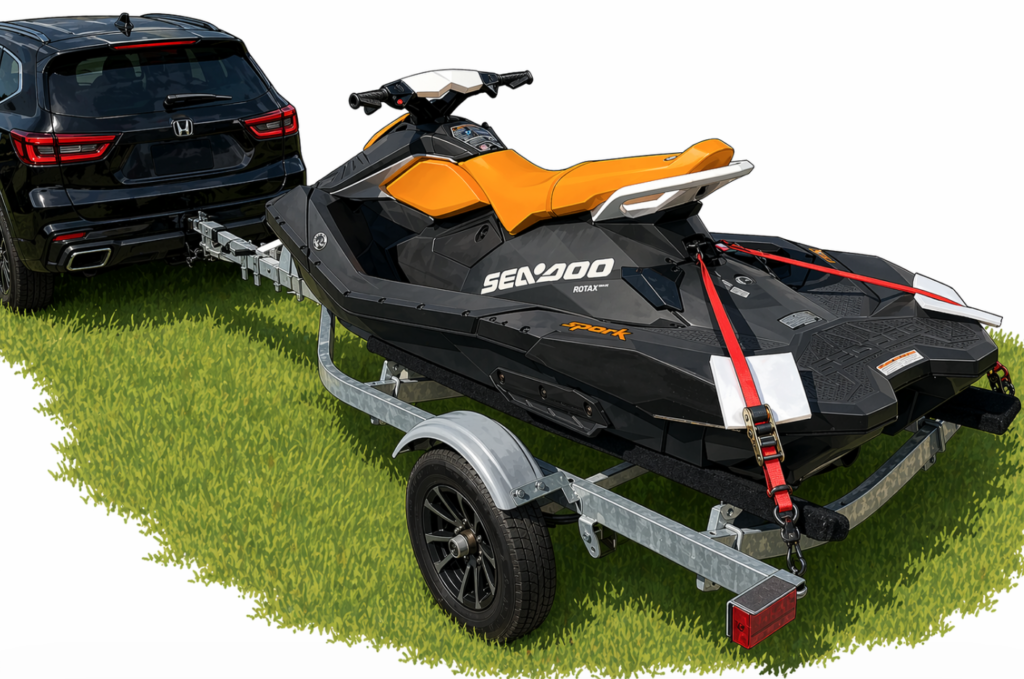
The fix isn’t complicated, but it does require a bit more attention to setup. The goal is to keep the strap pulling as cleanly as possible from the anchor point, without dragging across edges or resting on plastic. If there’s unavoidable contact, adding padding helps reduce long-term wear. It’s also worth being mindful of tension because locking everything down too aggressively doesn’t necessarily make it safer, and in this case, it can actually increase stress on the hull.
Once it’s set up correctly, the Spark holds just fine. It just demands a bit more precision compared to other Sea-Doo models.
Which retractable ratchet strap for your Spark?
Trailer with anchor points:
- Longer straps:
→ 1 in x 15 ft S-Hook - Shorter straps:
→ 2.5 ft or 4 ft - Extra stability for jet skis:
→ Three-Hook Retractable Strap
Trailer without anchor points
- Best for saltwater & brackish water durability:
→ All Stainless Steel Dual Lock - Balanced marine performance (most users):
→ Stainless Steel Dual Lock - Higher strength at lower cost:
→ Dual Lock Steel or Two-way Steel
Read more: Strapinno vs BoatBuckle: 2025 Retractable Ratchet Strap Comparison (Marine Use)
3) Sea-Doo Switch
If you’re coming from a regular Sea-Doo and stepping into a Switch, this is where things start to feel unfamiliar. The biggest difference is that there are no traditional rear hooks. Instead of a defined tie-down point, you’re working with a modular frame and pontoon structure, which changes how everything needs to be secured.
Because of that, straps don’t clip into place the way they normally would. They’re usually routed over the frame, around railings, or tied into structural mounting points. That works, but it also introduces a different kind of challenge. You’re no longer just holding the ski down- you’re stabilizing an entire platform. If the tension isn’t balanced properly, parts of that modular setup can shift slightly during transport, especially on longer drives.
Some owners notice that side sections or mounted components don’t feel as tight after a trip, particularly if they weren’t braced or secured independently.
The trailer setup matters more here too. With a compact trailer, the bow position becomes critical. If the front isn’t pulled in tight enough, you can end up with subtle movement or even slight overhang at the rear. On top of that, running straps over railings or frame edges can lead to surface wear if there’s no protection in place. It’s not immediate damage, but over time, those contact points start to show.
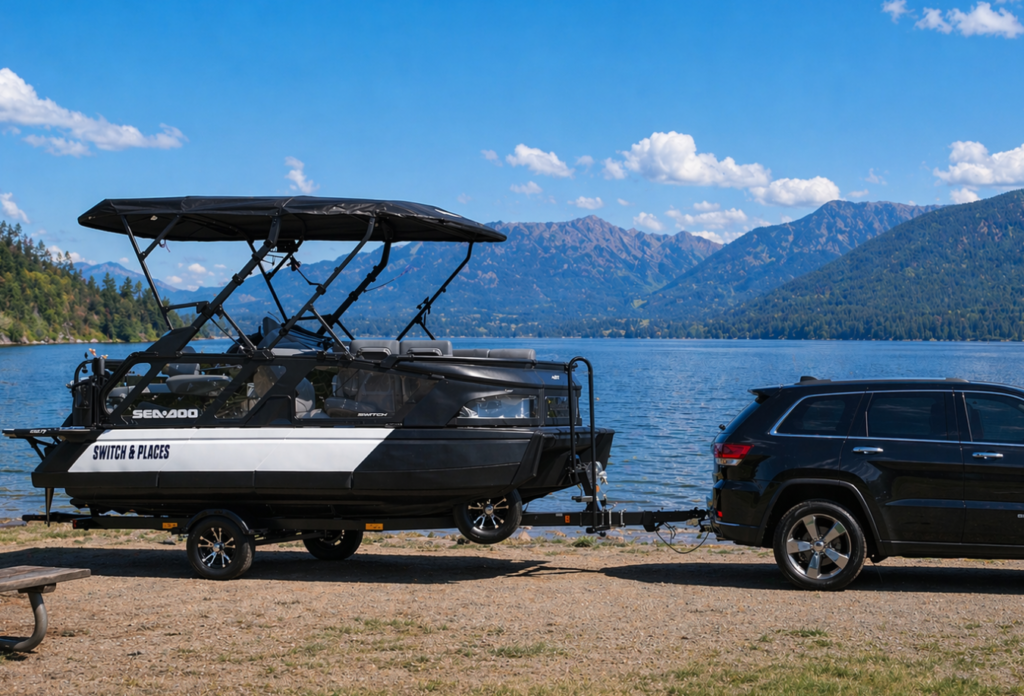
Once you understand how the Switch behaves, the setup becomes much more predictable. The bow should be pulled firmly into the winch to lock the position forward. From there, wider straps can be run over the outer frame, down to the trailer, keeping the load balanced from both sides. If there are removable or modular sections, securing those separately helps prevent any movement during transport.
Where Strapinno straps fit in
If you look at how most people secure a Sea-Doo Switch, the fundamentals are actually pretty straightforward. The bow gets pulled tight into the winch, and wide straps are run over the perimeter frame, down to the trailer. As long as the tension is even and the contact points are clean, the platform holds well. That’s the baseline and it works.
Where things tend to fall apart is actually the consistency. Because you’re dealing with a wider, modular frame, even small differences in tension from left to right can show up once you’re on the road. One side slightly tighter, the other with a bit of slack, and over time you start to get subtle movement across the pontoons or side sections.
This is where a retractable system like Strapinno starts to earn its place. It doesn’t change the way you secure the Switch, it just makes it easier to do it right. The straps stay controlled, there’s no loose webbing to manage, and tensioning becomes more precise. Instead of guessing or re-adjusting, you’re able to bring both sides down evenly and lock the structure in with a bit more confidence.
On the road, that consistency matters more than people expect. When straps are cleanly tensioned and fully managed, there’s less chance of slack developing, less movement across the frame, and nothing flapping or shifting at speed. The whole setup just feels tighter and more composed, especially over longer drives or rougher stretches.
It also changes the experience around loading and unloading. Traditional straps get the job done, but they add friction such as feeding webbing, dealing with extra length, making sure nothing twists or gets in the way. With a retractable system, everything stays in place. Hook, tension, and you’re done. It’s a small upgrade, but one that makes repeat use noticeably smoother.
At the end of the day, standard straps are still capable of securing a Switch properly. But if you trailer often, or you want a setup that feels more dialed in and reliable without extra effort, a retractable system helps you get there more consistently.
Will Strapinno Straps Handle a Sea-Doo Switch?
This is something Switch owners ask pretty often, especially once they realize how different the setup is compared to a regular jet ski. If you take a typical example, an 18ft 2023 Switch Cruise, you’re looking at roughly 2,800+ lbs for the boat itself, and just over 1,000 lbs for the trailer. When you’re securing it, what really matters is the load on the straps relative to the boat, not just the combined number. As a rule of thumb, your total Working Load Limit should comfortably exceed the weight of the boat, with some margin built in. With a multi-point setup like Strapinno’s retractable straps, the load is spread evenly across the frame instead of relying on one or two points.
In practice, that means a more balanced hold and less movement during transport. Paired with a properly tightened bow winch, the whole setup stays stable and controlled. So short answer yes, it’s more than capable, and it helps you secure the Switch more consistently.
Strapinno straps for your SeaDoo
| Product | Size | Material | WLL (per strap) | Breaking Strength (per strap) | Includes | Color |
|---|---|---|---|---|---|---|
| Dual Lock Transom Retractable Ratchet Strap – Stainless Steel | 1 7/8 in x 4 ft | Stainless-steel spring, bolt sets | 550 LBS (250KG) | 1,650 LBS (750KG) | 2 pcs in box, 2 mounting brackets & 4 bolt sets | Black, Blue |
| Dual Lock Transom Retractable Ratchet Strap – Steel | 1 7/8 in x 4 ft | Alloy Steel | 866 LBS (392KG) | 2,600 LBS (1180KG) | 2 pcs in box, 2 mounting brackets & 4 bolt sets | Black, Blue |
| Dual Lock Transom Retractable Ratchet Strap – All Stainless Steel | 1 7/8 in x 4 ft | Stainless-steel ratchet body, internal spring, S hook, bolt sets | 550 LBS (250KG) | 1,650 LBS (1360KG) | 2 pcs in box, 2 mounting brackets & 4 bolt sets | Black |
| Two-way Transom Retractable Ratchet Strap – Stainless Steel | 1 7/8 in x 4 ft | Stainless steel spring, bolt sets | 550 LBS (250KG) | 1,650 LBS (1,360KG) | 2 pcs in box, 2 extra 10″ extension straps, 4 stainless steel bolt sets | Black, Blue |
| Two-way Transom Retractable Ratchet Strap – Steel | 1 7/8 in x 4 ft | Alloy steel | 1,000 LBS (453KG) | 3,000 LBS (1,360KG) | 2 pcs in box, 2 extra 10″ extension straps, 4 bolt sets | Black |
| Boat Trailer Loop Transom Retractable Ratchet Straps | 1 in x 2.5 ft | Alloy steel | 800 LBS (363KG) | 2,400 LBS (1,088KG) | 2 pcs in box | Blue, Red |
| Boat Trailer Loop Transom Retractable Ratchet Straps | 1 in x 4 ft | Alloy steel | 800 LBS (363KG) | 2,400 LBS (1,088KG) | 2 pcs in box | Blue |
| Three-Hook Retractable Ratchet Strap | 1 in x 15 ft | Alloy steel | 1,000 LBS (453KG) | 3,000 LBS (1,360 KG) | 2 pcs in box | Red |